Energy is no longer a predictable line item on your balance sheet. It’s one of the most volatile costs in your operation, yet most manufacturers still manage it reactively.
The numbers make that hard to argue with. According to the US Bureau of Labor Statistics via FRED, average electricity costs jumped 41% from January 2021 to January 2026.
To put that in a different perspective, prices rose faster in five years than they had in the previous 15.
You’ve probably heard that rates always go up, which is true. But the forces driving this acceleration are structural, not cyclical. They don’t correct themselves when the economy stabilizes or when a supply chain disruption resolves.
Here’s what this article covers: why energy costs are rising, what AI data centers have to do with it, where prices are headed over the next decade, and why commercial solar solutions have become a serious financial decision for manufacturers.
Energy Costs Are Rising Fast
Looking back to FRED, the historical picture of energy costs is straightforward.
From 2006 through 2020, electricity costs climbed slowly year over year with some years, such as 2009, 2012, 2015, and 2016 showing a decrease in energy prices. However, on average the trend was a slow increase year over year.
It was gradual enough that most manufacturers could absorb the increases without significant disruption. Then 2021 happened. Prices started to increase sharply. In 2022, the increase between January and December was a remarkable 12.24% rise in prices.
Over the course of 5 years – January 2021 through January 2026 – energy prices rose 41%.
To put this in more concrete terms, if you were paying $10,000 per month in electricity in January 2021, you’re paying roughly $14,100 for that same energy today. That’s an extra $49,200 per year.
For manufacturers, energy isn’t an overhead abstraction. It’s baked into the cost of every unit you produce, every pound processed, and every hour of production. When electricity rates accelerate at this pace, it shows up in your margins whether you’re tracking it carefully or not.
What’s driven the costs up so far is only part of the story. The bigger pressure is what’s coming.
The AI Data Center Effect: Why Demand Is Outpacing Supply
AI data centers are a hot topic in 2026 for good reason. These data centers are permanent infrastructure developments, accelerating the load on the national grid, and changing the economics of energy for every industrial customer in the country.
To highlight the scale of data centers, the Environmental and Energy Study Institute reports that utility providers received more than 700 gigawatts (GW) of new power connection requests in 2025 alone.
For context, total US electricity consumption in 2023 was 477 GW. According to a 2024 report by the International Energy Agency, the AI industry is expected to consume 10 times more energy in 2026 than it did in 2023. By 2050, ICF projects that AI will grow total energy demand by 78%.
How does this relate to industries outside of AI?
Data centers often carry significant negotiating power with utilities because of the size of their load agreements. Manufacturers don’t always have the same leverage.
When utilities face higher infrastructure costs from grid expansion and capacity strain, those costs pass through to industrial customers, including your business whether you’re in manufacturing, retail, distribution, or more.
The demand side of the equation is clear; the supply side is where things get more complicated.
What the One Big Beautiful Bill Changed
The federal environment compounds an already stressed supply problem. Everyone wants more kilowatt-hours than we have, and the One Big Beautiful Bill added to the stress. It was signed into law on July 4, 2025, and set hard deadlines on federal solar tax credits that previously supported renewable energy buildout.
While residential solar tax credits expired at the end of 2025, commercial solar projects must be completed by the end of 2027 to claim the full federal tax credit (ITC). This tax credit covers between 30% and 50% of total commercial solar project costs.
Whether they are installing a large solar array or a smaller solar system, the savings from the ITC adds up. Here are four real-world examples from a few Artisun Solar clients and their ITC savings:
- Steel & Pipe Supply: $1.1 million | Payback in 5.3 years (average across 3 projects)
- Storm Products: $298,350 | Payback in < 1 year
- Champion Precast: $93,003 | Payback in 1.3 years
- Helluva: $31,716 | Payback in 1.7 years
How the One Big Beautiful Bill Changes Energy Generation
By directly reducing our domestic energy generation capacity with changes in the One Big Beautiful Bill, the downstream effect on energy supply is substantial. Rhodium Group projects new renewable energy generation capacity will shrink by as much as 62% by 2050 or the equivalent to 1,000 gas turbine plants.
Long-term modeling shows a loss of 330 GW of new capacity by 2035 as a direct result of these policy changes.
It’s the foundation of any Economics 101 class. What happens to energy prices when demand goes up and supply goes down?
Where Energy Prices Are Headed: The Long-Term Forecast
You don’t need a crystal ball to see where energy prices are headed. Local utility companies have already announced significant rate increases over the past 1-2 years:
Duke Energy announced a 14% rate increase for Indiana businesses, phased in through 2025 and 2026. Other increases have been seen throughout Iowa, Illinois, Ohio, and Missouri by as much as 50%.
This is the reality manufacturers are operating in and facing right now, and forecasts suggest this trend will continue. Wholesale energy prices are projected to increase 25% by 2030 and 74% by 2035.
As Artisun Solar’s Liam Kelly mentioned in his 2026 article, “Plastics Manufacturers Facing New Cost Pressure: Energy,” in Plastics Business Magazine, manufacturers navigate fluctuations in costs, labor, and supply chain disruptions.
Is your cost structure designed to absorb these energy increases?
Commercial Solar as an Operating Cost Management Tool
While commercial solar can certainly bring benefits impacting sustainability and environmental programs, commercial solar is also largely a financial incentive.
Here’s how commercial solar systems work.
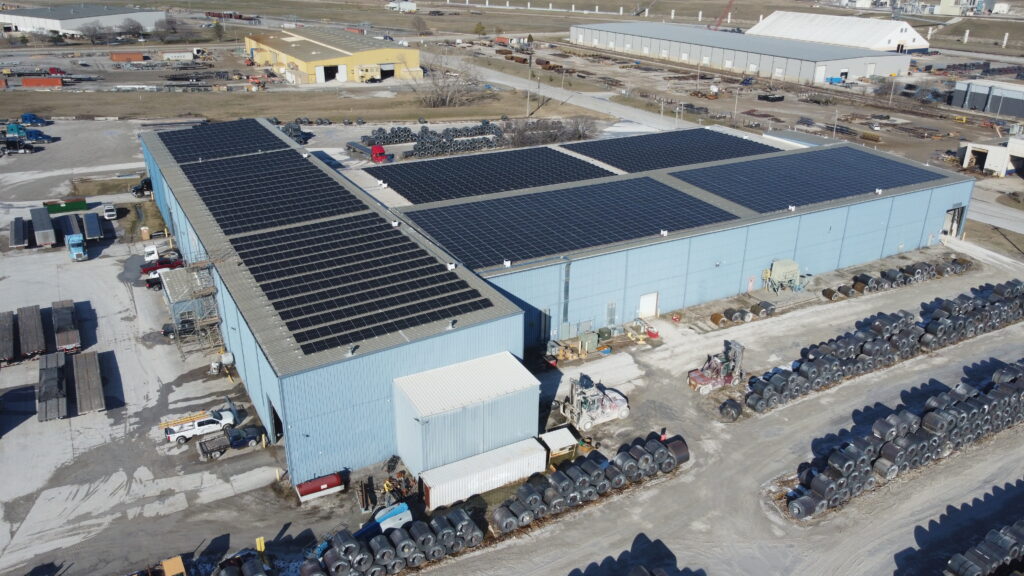
Solar panels are installed on your roof or available land in a system called a solar array. To get more technical, the panels produce direct current, which inverters convert into usable alternating current for the facility.
While this has clear sustainability benefits, solar is designed to stabilize your energy costs.
For some, it can fully eliminate the utility bill. For others, it reduces the monthly overhead by tens of thousands of dollars each month. This is in addition to tax strategy through depreciation.
Example: Commercial Solar Savings
Let’s say your manufacturing company is paying $14,000 each month for electricity in 2026, up from the $12,000 you paid each month in 2024.
If your solar array offsets 50% of your facility’s needs, the annual savings come to roughly $85,000. Expanded for the solar system’s lifetime with a conservative 3% annual rate increase assumption, and your projected electrical savings surpass $3.7 million.
If available in your area, net metering also sells any surplus energy back to the grid for bill credits. Learn more about net metering and net billing here.
Adding Energy Storage
Combining solar power systems with battery energy storage systems (BESS) extends on-site energy management during peak hours when energy costs are highest. These systems capture solar electricity and allow you to offset energy needs throughout the day, even when the sun is lower in the sky and solar conversion produces less electricity.
With the combination of BESS and commercial solar installations, companies optimize the entire process of energy generation and storage while improving on-site energy management, operational efficiency, and electrical savings.
You don’t have to offset 100% of your energy to make the numbers work. Even a partial offset of total energy usage produces substantial cost reduction year over year, whether you use your roof space or ground to generate power.
How to Choose a Commercial Solar Partner
As you research the benefits of solar, whether it’s to generate electricity to power your facility or combining with solar batteries, you quickly reach the point of needing a commercial solar partner.
A good commercial solar partner will manage system designs, find the best installation location, navigate labor costs, or determine when more panels wouldn’t be beneficial.
This decision deserves the same rigor you’d apply to any capital expenditure.
Questions to Ask a Commercial Solar Partner
Whether you get a proposal from Artisun Solar or another commercial solar company, these are questions you should ask before signing any contract with a commercial solar partner:
What incentives and tax credits are available, and who claims them?
Leasing a building doesn’t disqualify you from solar, but the building owner will benefit from the federal tax credit.
What financing options are available, including a solar lease or power purchase agreement, and do they require little or no upfront cost?
Some states also provide C-PACE financing for commercial solar projects.
How is depreciation handled, including MACRS, and how could it affect tax liability, additional tax savings, and long-term savings?
Commercial solar panels do more than just produce energy. When solar is installed, commercial property owners can work with their CFO and accounting teams to maximize the tax strategies.
How accurate are the savings projections, and what assumptions are included?
They should be able to explain clearly what contributed to the projections, such as power grid rate increases and facility energy usage.
Is the system designed to produce more than 100% of the company’s energy needs?
In some cases, excess generation can be an asset depending on your utility company’s net metering or net billing policies.
Who handles permits, inspections, and utility approvals?
As the expert, your commercial solar partner should be leading these processes.
How many commercial solar projects do they handle annually?
As more residential solar companies enter the commercial solar market, it’s important to learn if they handle a few commercial solar projects or 50+ commercial solar projects every year like we do here at Artisun Solar. Residential installations are vastly different from commercial installations.
A reputable partner will walk you through project size, commercial solar installation costs, solar panel system design, solar installation, and the incentive structure specific to your facility and state. Project managers should keep you up to date, and know that your commercial building is in good hands.
The Bottom Line: Commercial Solar Considerations
Return to the core question: is your business managing energy proactively or reactively? Here’s what the data says:
- Manufacturing energy costs have risen 41% in five years.
- AI data centers are adding unprecedented demand to a grid that isn’t expanding fast enough to absorb it.
- Policy changes are reducing new solar energy capacity by hundreds of gigawatts.
- Wholesale energy price forecasts point to a 25% increase by 2030 and a 74% increase by 2035.
Commercial solar gives manufacturers a 40-year tool to stabilize one of their most volatile cost inputs, improve energy savings, and lower operating costs. The federal commercial solar tax credit covers up to half of total project costs, and many commercial solar clients see a payback period within 5 years.
But with the commercial solar tax credits ending in 2027, it’s time to run the numbers on your facility. Start your free solar analysis at www.artisunsolar.com.
Frequently Asked Questions
How much can commercial solar save a manufacturer?
The savings depend on your current energy consumption, local utility rates, and system size. A system should be designed for your facility rather than a one-size-fits-all approach.
What is the federal solar tax credit for commercial projects?
The federal investment tax credit covers 30% to 50% of total commercial solar project costs. To claim the full credit, commercial projects must be completed by December 31, 2027. A qualified commercial solar installer can walk you through the specific eligibility requirements for your facility, including incentives from the federal government, utility companies, and other incentive programs.
How long does it take to see a return on a commercial solar investment?
Payback periods vary based on system size, project cost, incentives, local utility rates, and add-ons such as EV chargers. When the federal tax credit and state and federal depreciation are factored in together, full payback on the 40-year asset can be within 5 years.