Commercial solar is a long-term way for small business owners and commercial facility managers to stabilize and reduce rising electricity costs by generating their own power.
Energy costs are climbing faster than most businesses can absorb, driven by AI data center demand and a shrinking supply of new generation capacity, so margins are getting squeezed now, not someday.
While low-cost adjustments and efficiency upgrades help at the margins, commercial solar is the tool that can lock in more predictable energy expenses and deliver outsized savings, especially while the federal tax credit remains available through the end of 2027.
After 15 years in commercial solar, we’ve ridden this “solar-coaster” before. In this article, we break down why power prices are rising, which cost-saving moves make sense before solar, how commercial solar projects and incentives work, and what real business results look like in practice.
Key Takeaways
- Electricity costs jumped 41% between January 2021 and January 2026, and AI data center demand is a primary driver of that increase.
- Small businesses carry energy costs differently than larger companies. A spike in the utility bill hits margins immediately, with far less room to absorb it.
- Low-cost habits and efficiency upgrades can trim expenses, but commercial solar is the only solution that fundamentally changes the cost structure.
- Commercial solar tax credits (30% to 50% of project cost) expire for projects not placed in service by December 31, 2027.
- Real installations, like Village True Value’s 1.6-year payback and Raynor Garage Doors’ drop from $500/month to under $50/month, show the numbers hold up outside a sales pitch.
Running a small business means watching every line item on the balance sheet, and none has been harder to predict lately than the electric bill.
Unlike a large manufacturer with a facilities team and a dedicated energy budget, a small business owner often manages this cost alongside payroll, inventory, and everything else on the to-do list.
When that bill jumps unexpectedly, there’s no cushion to absorb it quietly. It shows up in your margins right away.
Commercial solar has become one of the most effective ways for small businesses to manage that risk. It’s a financial decision that changes how you pay for electricity for the next several decades.
Why Are Electricity Rate Costs Increasing?
Simply put, demand for electricity is rising faster than the grid can supply it, and that imbalance is pushing rates up for every business, regardless of size or industry.
According to the US Bureau of Labor Statistics via FRED, average electricity costs jumped 41% from January 2021 to January 2026.
To put that in perspective, prices rose faster in five years than in the previous fifteen combined.
What’s driving that demand?
AI data centers are a major factor.
Total US electricity consumption in 2023 was 477 gigawatts (GW). According to a 2024 report by the International Energy Agency, the AI industry is expected to consume 10 times more energy in 2026 than it did in 2023.
Looking further out, ICF projects that AI will grow total energy demand by 78% by 2050.
What’s happening on the natural gas supply side?
While demand is climbing, new energy generation capacity is shrinking. Changes tied to the One Big Beautiful Bill are reducing incentives for renewable energy buildout.
Rhodium Group projects new renewable energy generation capacity will shrink by as much as 62% by 2050, the equivalent of 1,000 gas turbine plants never getting built. Long-term modeling shows a loss of 330 GW of new capacity by 2035 as a direct result of these policy changes.
It’s a simple equation:
- Higher demand
- Lower supply
Electricity demand typically peaks in the afternoon and early evening, when the grid is under the most pressure and increased demand pushes prices higher.
The result is higher energy prices, and there’s no indication that trend reverses anytime soon.
What Can a Small Business Do to Offset Energy Costs?
Every small business has options, ranging from free adjustments to major capital investments. The best approach usually involves a combination of all three.
Low-cost and no-cost changes
These are easier changes that won’t necessarily transform your energy bill overnight. However, they add up, especially in a facility running lights and equipment for extended hours.
- Install motion-detector lighting for storage rooms, bathrooms, and other non-essential spaces.
- Keep airflow vents clear of inventory, boxes, and equipment so HVAC systems don’t work harder than necessary.
- Unplug idle electronics and equipment at the end of the day. Standby power draws add up over a year.
- Program thermostats for off-hours so heating and cooling scale back when the building is empty.
Efficiency upgrades
This is the next typical phase of energy-focused upgrades. These require a modest investment but pay for themselves through reduced consumption.
- Add weather stripping around doors and windows to stop conditioned air from leaking out.
- Switch to LED lighting throughout the facility. LEDs use a fraction of the electricity of traditional fixtures and last significantly longer.
- Keep up with HVAC maintenance. A poorly maintained system works harder and costs more to run every single month.
Long-term solutions: commercial solar
Upgrading your facility with energy-efficient products and processes can be a start, but the long-term outlook for energy costs pressures small business to take a more aggressive approach.
Low-cost habits and efficiency upgrades help you spend less on the same broken system, but commercial solar changes the system itself.
Instead of paying an unpredictable monthly rate to your utility, your business generates a meaningful portion, sometimes all, of its own electricity, at a cost that’s fixed and known in advance. It also supports corporate sustainability objectives and strengthens brand image among the many business benefits.
Here’s what makes 2026 the time to act: the commercial solar Investment Tax Credit (ITC) currently covers 30% to 50% of total project costs, but it’s not permanent.
Residential solar tax credits already expired at the end of 2025. Commercial projects must be fully installed, connected, and operational by December 31, 2027, to claim the credit.
Given that most commercial solar projects take several months to more than a year from initial assessment to completion, the window to start is narrower than it looks. Construction timelines are already stretching as more commercial customers race to build by the end of 2027.
Want to get started on a solar project for your small business? Click here to send us a message to learn more.
Why Solar Works for Small Businesses
Commercial solar offers small businesses a strategic advantage by transforming how energy costs impact their operations. Beyond just savings, it provides stability, predictability, and a competitive edge in managing one of the most significant expenses.
Rate predictability vs. the national average
Your utility rate moves with the market.
Fuel costs, infrastructure upgrades, and regional demand all factor into what you pay; in 2025, the national average U.S. price was 13.63¢ per kWh, a useful benchmark for comparing your current electricity rate.
A solar system, called a solar array, functions like a fixed-rate mortgage against a variable-rate loan.
One is predictable. The other moves whenever the lender decides. Solar locks in your energy cost for the system’s lifespan, typically 40 years, while your neighbor’s utility bill keeps climbing.
Peak demand charges
Many commercial electricity bills include a demand charge, a separate fee based on the highest 15-minute average power draw during your billing period, not just how much electricity you used overall.
Think of it as paying for the size of the pipe you need rather than the total water that flows through it.
Demand charges can represent a meaningful share of a commercial bill, and solar production during your highest-use daylight hours directly reduces that peak draw, which lowers this charge alongside your regular usage costs.
Tax depreciation and strategy
Beyond the ITC, commercial solar assets qualify for accelerated depreciation. This is separate from the tax credit itself.
It allows you to deduct the depreciable basis of the solar equipment, often in the very first year the system is placed in service.
For a business paying a meaningful tax bill, this depreciation benefit compounds with the ITC to significantly shorten how long the project takes to pay for itself. We recommend discussing this further with your tax advisor to learn how this applies to your specific situation.
Net metering and net billing
When your solar array produces more electricity than your business uses at a given moment, that surplus typically goes back to the grid. What you get credited for it depends on your utility.
Some utilities, offer rebates or feed-in tariffs that can change the economics of exporting power.
Under net metering, you’re credited at the retail rate, kilowatt-hour for kilowatt-hour. Think of it like a company’s rollover vacation policy: unused hours (or in this case, unused kilowatt-hours) carry forward and offset your usage during a higher-demand month.
Under net billing, that surplus is credited at a lower wholesale rate, and it’s converted to a dollar value rather than a straight kWh credit. It’s closer to trading in a used textbook: you paid full price, but the credit you receive back is worth less than what you originally spent.
Neither structure eliminates the value of going solar. It simply changes how your system should be sized and designed. This is exactly why the design process matters as much as the installation itself.
What Does the Commercial Solar Process Actually Look Like?
A commercial solar project is best approached as a turnkey process with the right partner, and understanding the phases upfront removes a lot of the uncertainty that keeps business owners on the sidelines.
- Energy audit and bill analysis. A qualified solar partner like Artisun Solar reviews 12 months of your utility bills to understand your usage patterns, seasonal peaks, and current rate structure. This is the foundation every other decision is built on.
- Custom solar design. Based on your facility’s roof or available land, your usage profile, and your utility’s specific billing structure (net metering versus net billing), your system is sized to match your actual needs, not a generic template, with services covering design through installation.
- Proposal and timeline. You’ll receive a clear breakdown of project costs, projected savings, financing options, and the practical details needed to understand the process, along with a realistic installation timeline.
- Your decision, followed by execution. Once you move forward, your partner should manage permitting, utility interconnection applications, equipment procurement, and installation from start to finish. Turnkey project management helps maintain high-quality standards across permitting, procurement, construction, and commissioning.
- Energy production and monitoring. Once your system is live, ongoing performance monitoring tracks output against projections, flags any issues early, and confirms the system continues delivering the savings it was designed for.
A good commercial solar partner should be able to explain this timeline clearly and set realistic expectations for your specific facility. If they can’t, that’s a red flag worth taking seriously.
Real Businesses Running the Numbers
Case studies are useful because they replace assumptions with documented results.
 Village True Value, a retail hardware store in Hot Springs, Arkansas, deals with seasonal electricity spikes that are difficult for any retailer to plan around.
Working with Artisun Solar, the store installed a 278-panel rooftop system sized at 106.2 kW DC, which offsets 93.4% of the store’s annual electricity usage.
Annual electrical savings top $13,000 with lifetime savings projected to reach $583,000. And the system was fully paid back within 2 years.
Nearly everything that used to go toward the utility bill can now go toward inventory, staffing, or expansion instead.
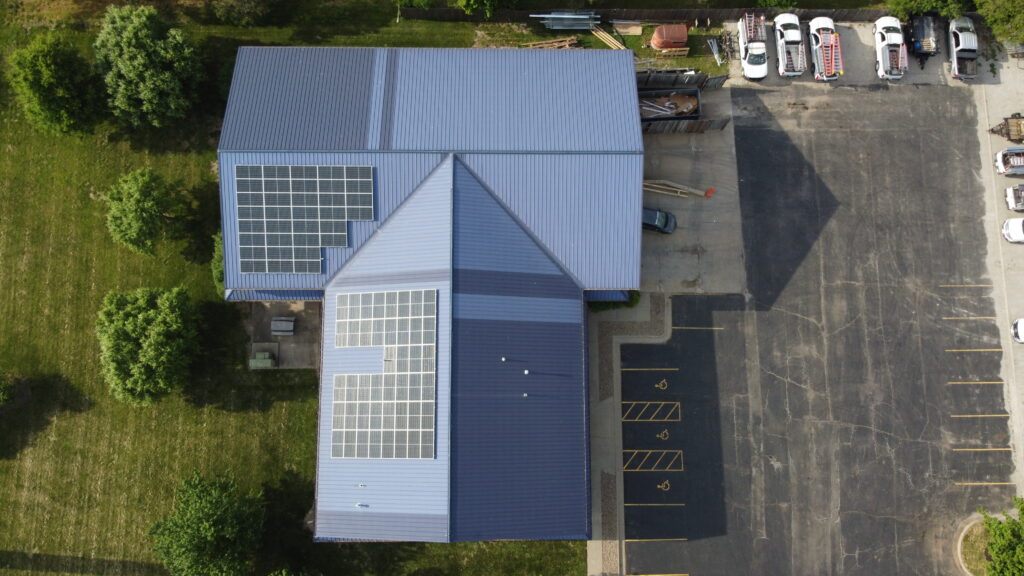
 Raynor Garage Doors of Kansas City in Shawnee, Kansas, installed a 32.4 kW DC rooftop system with a straightforward goal: turn a variable expense into a predictable one.
The system, producing 20.0 kW AC, delivers $4,066 annually in electrical savings with lifetime savings projected at $182,000.
Sheila Guthrie, President of Raynor Garage Doors of Kansas City, was shocked to see the company’s utility bills after solar was installed.
“Our typical Evergy bill ran $450 to $600 per month and is now less than $50 per month,” she said. “I was surprised when my first bill came and thought there must be some mistake.”
These are two different industries with different systems, but the goal remains the same: energy costs were controlled for decades to come.
Stop Treating High Energy Costs as a Fixed Cost of Doing Business
For years, a rising utility bill was something business owners simply absorbed. It was the cost of keeping the lights on, literally, and there wasn’t much of an alternative.
That’s no longer true.
Solar isn’t only a sustainability checkbox. For most small business owners, it’s primarily a financial decision, one that stabilizes your largest uncontrollable expense and puts real money back into the business every single month.
With the commercial solar tax credit set to expire for projects not operational by the end of 2027, the timeline to capture that full benefit is shrinking.
The first step is straightforward: pull twelve months of your utility bills and request a site-specific solar analysis. From there, you’ll have real numbers, not assumptions, to decide whether solar makes sense for your facility.
Frequently Asked Questions
What happens to the solar tax credit after 2027?
The commercial solar Investment Tax Credit currently covers 30% to 50% of total project costs, but it only applies to projects placed in service, meaning fully installed, connected to the grid, and producing electricity, by December 31, 2027. Projects that miss this deadline lose eligibility for the credit. Because most commercial installations take several months to more than a year to complete, starting the process well before the deadline matters.
How quickly can a small business see savings from solar?
Many businesses see reduced electricity costs starting the month the system is turned on. Payback periods vary based on system size, project cost, financing structure, and local utility rates, but real-world examples range from under two years (Village True Value) to under six years (Raynor Garage Doors) after accounting for tax incentives and depreciation.
What kind of ROI does a commercial solar system usually deliver?
ROI depends heavily on your facility’s energy usage, local utility rates, and how the system is financed. When the federal tax credit and accelerated depreciation are factored in together, many commercial solar clients see full payback well within the system’s 25- to 30-year lifespan, often in five years or less.
What happens to a solar system during a power outage?
A standard grid-tied solar system shuts down during a grid outage as a safety measure, protecting utility workers repairing the lines. Businesses wanting power during outages typically pair their solar array with battery storage, which allows stored energy to keep critical systems running independent of the grid.
What if a business leases its building instead of owning it?
Leasing a building doesn’t automatically disqualify a business from installing solar, but the property owner typically claims the federal tax credit since they own the underlying asset. This conversation should happen early with your landlord, and some financing structures, like C-PACE, are specifically designed around property ownership.
What does ongoing maintenance look like for a commercial solar system?
Commercial solar systems require very little hands-on maintenance. Most quality panels degrade at just 0.3% to 0.6% annually, and many systems run for years with nothing more than periodic performance monitoring. Snow, rain, and typical weather don’t require manual intervention in most installations.
Can a solar system be expanded later if the business grows?
Yes. Many commercial solar installations are designed with future growth in mind, and systems can be planned to be better suited to expansion so you can determine whether to reserve extra roof space, inverter capacity, or room for battery integration now. This is a conversation worth having during the initial design phase so your system isn’t built in a way that limits future expansion.
Definitions
- AC (Alternating Current): The standard form of electricity used to power commercial equipment, lighting, and HVAC systems. Solar panels generate DC power, which gets converted to AC by an inverter.
- DC (Direct Current): The type of electricity solar panels naturally produce before it’s converted for use in a facility.
- Demand Charge: A fee based on the highest 15-minute average power draw during a billing period, separate from your total electricity usage charge.
- Investment Tax Credit (ITC): A federal tax credit that reduces the amount owed in taxes based on a percentage of total commercial solar project costs.
- kWh (Kilowatt-Hour): A unit measuring electricity used or generated over time. One kWh equals the energy used by a 1,000-watt device running for one hour.
- Net Billing: A utility credit structure where surplus solar energy sent to the grid is credited as a dollar value at a lower wholesale rate.
- Net Metering: A utility credit structure where surplus solar energy is credited at the full retail rate, kilowatt-hour for kilowatt-hour.
- Payback Period: The amount of time it takes for energy savings to equal the total cost of a solar installation.
- Solar Array: A group of connected solar panels installed on a roof or on the ground to generate electricity for a facility.